Thursday, May 23, 2019

Morse Code Is 175 Years Old and Still as Useful as Ever

The first message sent by Morse code’s dots and dashes across a long distance traveled from Washington, D.C., to Baltimore on Friday, May 24, 1844-175 years ago. It signaled the first time in human history that complex thoughts could be communicated at long distances almost instantaneously. Until then, people had to have face-to-face conversations; send coded messages through drums, smoke signals and semaphore systems; or read printed words.
Thanks to Samuel F.B. Morse, communication changed rapidly, and has been changing ever faster since. He invented the electric telegraph in 1832. It took six more years for him to standardize a code for communicating over telegraph wires. In 1843, Congress gave him $30,000 to string wires between the nation’s capital and nearby Baltimore. When the line was completed, he conducted a public demonstration of long-distance communication.
Morse wasn’t the only one working to develop a means of communicating over the telegraph, but his is the one that has survived. The wires, magnets and keys used in the initial demonstration have given way to smartphones’ on-screen keyboards, but Morse code has remained fundamentally the same, and is still—perhaps surprisingly—relevant in the 21st century. Although I have learned, and relearned, it many times as a Boy Scout, an amateur radio operator and a pilot, I continue to admire it and strive to master it.

Easy sending

Morse’s key insight in constructing the code was considering how frequently each letter is used in English. The most commonly used letters have shorter symbols: “E,” which appears most often, is signified by a single “dot.” By contrast, “Z,” the least used letter in English, was signified by the much longer and more complex “dot-dot-dot (pause) dot.”
In 1865, the International Telecommunications Union changed the code to account for different character frequencies in other languages. There have been other tweaks since, but “E” is still “dot,” though “Z” is now “dash-dash-dot-dot.”
The reference to letter frequency makes for extremely efficient communications: Simple words with common letters can be transmitted very quickly. Longer words can still be sent, but they take more time.
 

Going wireless

The communications system that Morse code was designed for—analog connections over metal wires that carried a lot of interference and needed a clear on-off type signal to be heard—has evolved significantly.
The first big change came just a few decades after Morse’s demonstration. In the late 19th century, Guglielmo Marconi invented radio-telegraph equipment, which could send Morse code over radio waves, rather than wires.
The shipping industry loved this new way to communicate with ships at sea, either from ship to ship or to shore-based stations. By 1910, U.S. law required many passenger ships in U.S. waters to carry wireless sets for sending and receiving messages.
After the Titanic sank in 1912, an international agreement required some ships to assign a person to listen for radio distress signals at all times. That same agreement designated “SOS”—“dot-dot-dot dash-dash-dash dot-dot-dot”—as the international distress signal, not as an abbreviation for anything but because it was a simple pattern that was easy to remember and transmit. The Coast Guard discontinued monitoring in 1995. The requirement that ships monitor for distress signals was removed in 1999, though the U.S. Navy still teaches at least some sailors to read, send and receive Morse code.
Aviators also use Morse code to identify automated navigational aids. These are radio beacons that help pilots follow routes, traveling from one transmitter to the next on aeronautical charts. They transmit their identifiers—such as “BAL” for Baltimore—in Morse code. Pilots often learn to recognize familiar-sounding patterns of beacons in areas they fly frequently.
There is a thriving community of amateur radio operators who treasure Morse code, too. Among amateur radio operators, Morse code is a cherished tradition tracing back to the earliest days of radio. Some of them may have begun in the Boy Scouts, which has made learning Morse variably optional or required over the years. The Federal Communications Commission used to require all licensed amateur radio operators to demonstrate proficiency in Morse code, but that ended in 2007. The FCC does still issue commercial licenses that require Morse proficiency, but no jobs require it anymore.
A Morse code device, which is used to sends dots and dashes. Getty Images

Blinking Morse

Because its signals are so simple—on or off, long or short—Morse code can also be used by flashing lights. Many navies around the world use blinker lights to communicate from ship to ship when they don’t want to use radios or when radio equipment breaks down. The U.S. Navy is actually testing a system that would let a user type words and convert it to blinker light. A receiver would read the flashes and convert it back to text.
Skills learned in the military helped an injured man communicate with his wife across a rocky beach using only his flashlight in 2017.

Other Morse messages

Perhaps the most notable modern use of Morse code was by Navy pilot Jeremiah Denton, while he was a prisoner of war in Vietnam. In 1966, about one year into a nearly eight-year imprisonment, Denton was forced by his North Vietnamese captors to participate in a video interview about his treatment. While the camera focused on his face, he blinked the Morse code symbols for “torture,” confirming for the first time U.S. fears about the treatment of service members held captive in North Vietnam.
Blinking Morse code is slow, but has also helped people with medical conditions that prevent them from speaking or communicating in other ways. A number of devices—including iPhones and Android smartphones—can be set up to accept Morse code input from people with limited motor skills.
There are still many ways people can learn Morse code, and practice using it, even online. In emergency situations, it can be the only mode of communications that will get through. Beyond that, there is an art to Morse code, a rhythmic, musical fluidity to the sound. Sending and receiving it can have a soothing or meditative feeling, too, as the person focuses on the flow of individual characters, words and sentences. Overall, sometimes the simplest tool is all that’s needed to accomplish the task.

Article Courtesy Newsweek Tech News

Tuesday, May 21, 2019

NASA Invites Public To Submit Names To Fly Aboard Next Mars Rover


Although it will be years before the first humans set foot on Mars, NASA is giving the public an opportunity to send their names, etched on microchips, to the Red Planet with NASA's Mars 2020 rover, which represents the initial leg of humanity’s first round trip to another planet.

The rover is scheduled to launch as early as July 2020, with the spacecraft expected to touch down on Mars in February 2021.

The rover, a robotic scientist weighing more than 2,300 pounds, will search for signs of past microbial life, characterize the planet's climate and geology, collect samples for future return to Earth, and pave the way for human exploration of the Red Planet.

As we get ready to launch this historic Mars mission, we want everyone to share in this journey of exploration, said Thomas Zurbuchen, associate administrator for NASA's Science Mission Directorate  in Washington. It’s an exciting time for NASA, as we embark on this voyage to answer profound questions about our neighboring planet, and even the origins of life itself.

The opportunity to send your name to Mars comes with a souvenir boarding pass and frequent flyer points. This is part of a public engagement campaign to highlight missions involved with NASA's journey from the Moon to Mars. Miles are awarded for each flight, with corresponding digital mission patches available for download. More than 2 million names flew on NASA's InSight mission to Mars, giving each flyer about 300 million frequent flyer miles.

From now until Sept. 30th, you can add your name to the list and obtain a souvenir boarding pass to Mars. Point your web browser to:

https://go.nasa.gov/Mars2020Pass

The Microdevices Laboratory at NASA's Jet Propulsion Laboratory in Pasadena, California, will use an electron beam to etch the submitted names onto a silicon chip with lines of text smaller than one-thousandth the width of a human hair. At that size, more than a million names can be inscribed on a single dime-size microchip. The chip will ride on the rover under a glass cover.

NASA will use Mars 2020 and other missions to prepare for human exploration of the Red Planet. As another step toward that goal, NASA is returning American astronauts to the Moon in 2024. Government, industry and international partners will join NASA in a global effort to build and test the systems needed for human missions to Mars and beyond.

The Mars 2020 Project at JPL manages rover development for SMD. NASA's Launch Services Program, based at the agency's Kennedy Space Center in Florida, is responsible for launch management. Mars 2020 will launch from Cape Canaveral Air Force Station in Florida.

For more information on Mars 2020, visit: https://www.nasa.gov/mars2020

Friday, May 10, 2019

Hi everybody. My name is Giz, and I am the Chief Engineer of W2XBSradio. My human started this
blog and one of his friends that lives far away in a place called Arizona, suggested that I put up a
picture of myself. As you know I post regularly on my humans Facebook page, so now that I know he
has a blog, you will see more of me in future posts here too. More Later! giz

Friday, May 3, 2019

Passive WiFi On Microwatts

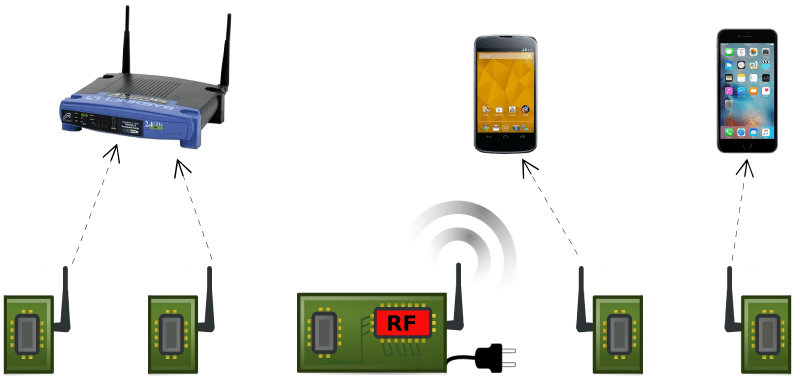
A lot of you use WiFi for your Internet of Things devices, but that pretty much rules out a battery-powered deployment because WiFi devices use a lot of juice. Until now. Researchers at the University of Washington have developed a passive WiFi implementation that uses only microwatts per device.
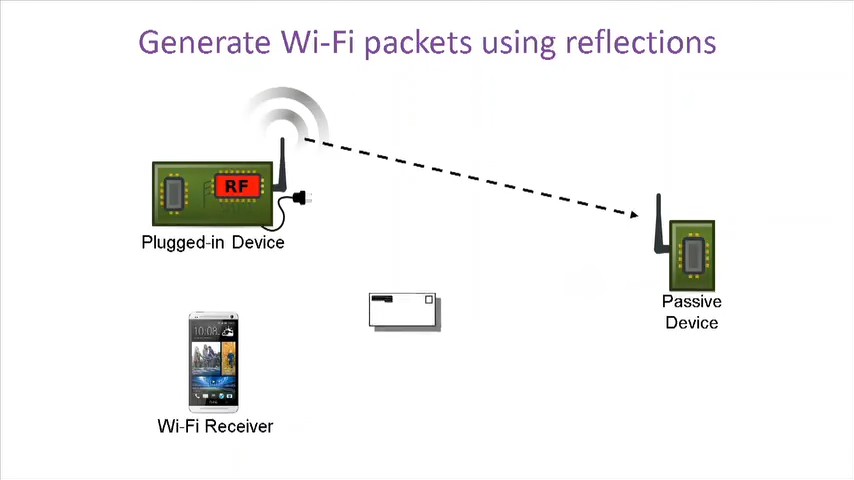
Working essentially like backscatter RFID tags do, each node has a WiFi antenna that can be switched to either reflect or absorb 2.4 GHz radiation. Your cell phone, or any other WiFi device, responds to this backscattered signal. All that’s missing is a nice steady signal to reflect.
passive_wifi-shot0008A single, plugged-in unit provides this carrier wave for multiple WiFi sensor nodes. And here’s the very clever part of the research: to keep the carrier from overwhelming the tiny modulated signal that’s coming from the devices, the plugged-in unit transmits off the desired frequency and the battery-powered units modulate that at just the right difference frequency so that the resulting (mixed) frequency is in the desired WiFi band.
If you’re a radio freak, you’ll recognize the WiFi node’s action being just like a frequency mixer. That’s what the researchers (slightly mysteriously) refer to as the splitting of the analog transmission stage from the digital. The plugged-in unit transmits the carrier, and the low-power nodes do the mixing. It’s like a traditional radio transmitter, but distributed. Very cool.
There’s a bunch more details to making this system work with consumer WiFi, as you’d imagine. The powered stations are responsible for insuring that there’s no collision, for instance. All of these details are very nicely explained in this paper (PDF). If you’re interested in doing something similar, you absolutely need to give it a read. This idea will surely work at lower frequencies, and we’re trying to think of a reason to use this distributed transmitter idea for our own purposes.
And in case you think that all of this RFID stuff is “not a hack”, we’ll remind you that (near-field) RFID tags have been made with just an ATtiny or with discrete logic chips. The remotely-powered backscatter idea expands the universe of applications.

Video Link: Video

Thursday, May 2, 2019


Listen to my rock radio show The Sanforized Hour. Heard every Friday Evening at 9pM Eastern (2am UTC) for the U.S. and repeated Saturdays at 5pM Eastern 21:00 UTC for the U.K and the continent. The Sanforized Hour Every Friday and Saturday on X1 - Albany N.Y.'s Home For Online Rock.

Wednesday, May 1, 2019

Netflix’s new high-quality audio adjusts to match your internet speeds

Netflix is rolling out an upgrade to its audio streaming technology that increases the maximum bitrate of its audio and allows it to adjust based on the speed of your internet connection. The streaming service’s new high-quality audio increases the maximum bitrate of a 5.1 audio mix to 640 kbps, and a Dolby Atmos mix to 768 kbps. The bitrate will also scale based on your internet speed, and can drop as low as 192 kbps in order to stop the video from having to buffer. The streaming service has used this adaptive approach before for its video feeds, which adjust dynamically to prevent them from cutting out. However, until now, the bitrate of a show’s audio has been determined at the beginning of a stream, with no option to adjust it once it has started. That could mean you’re stuck with lower-quality audio when your internet connection has more capacity, or a show has to buffer because it’s stuck on a higher bitrate. Even at Netflix’s maximum 5.1 audio bitrate of 640 kbps, it’s still compressing the audio a lot compared to the 24-bit / 48 kHz mastering sample frequency. But Netflix chose this bitrate because it believes it’s indistinguishable from the lossless master track, and hence you’d see no benefit from a higher bitrate. It adds that, over time, it expects these bitrates to change based on how efficient its encoders become. Netflix’s new high-quality audio is launching today. Courtesy The Verge News

Monday, April 29, 2019

Worlds Largest Wooded Radio Tower

The radio tower located in Gliwice, Poland (pronounced Glee Veet Say) is believed to be the tallest wooden structure in the world at 387 feet.  Constructed in 1935 by the German company Lorenz,  with help from Siemens, Telefunken, and others, it went into service on December 23, 1935 to replace a smaller transmitter located on Raudener Street in Gliwice.

The tower is a masterpiece of wood engineering,  constructed with impregnated Larch wood with a fascinating lattice structure of  beams. All connections were made with bolts made of ore,  because bolts of iron would have absorbed the transmitter signals. The larch wood was chosen for it's resistance to vermin and atmospheric conditions.   There is not a single iron nail in the tower.

Most radio towers built in Germany before 1945 were built of wood and the Gliwice tower is the only still standing.  The rest  were demolished between 1945 and 1983.  Today the tower supports multiple transmission antennas for mobile phone services and a low power FM transmitter.

The tower is diligently maintained, preserved and repaired every year. To reach the top, workers must climb a ladder with 365 steps.   Scientists from the Silesian University of Technology expect the tower to last another 20 years. The tower looks especially attractive after dusk, illuminated with eight massive spotlights and is visible for many miles  creating a lasting impression with visitors.

On August 31, 1939, the Germans staged a fake "Polish" attack on the station which was later used as justification for the Invasion of Poland.  During the cold war the Gliwice tower was used for jamming western medium wave transmitters broadcasting in Polish.

History Of W2XBS

I recently received a very nice letter from K1AAG, George Dupee of Palm Beach Gardens, Florida, regarding an article he came across on the history behind my call sign, W2XBS.

George's article is taken from a Boston Red Sox e-mail newsletter.

"On this day in 1939, the first televised Major League baseball game was televised on station W2XBS, the station that was to become WNBC-TV. Announcer Red Barber called the game between the Cincinnati Reds and the Brooklyn Dodgers at Ebbets Field in Brooklyn, New York. At that time, television was still in its infancy.

Regular programming did not yet exist, and very few people owned television receiving equipment. As a matter of fact, there were only about 400 in the New York City area. Not until 1946 did regular network broadcasting catch on in the United States, and only in the mid 1950's did television sets become common in the American household.

In 1939, the Worlds Fair -- which was being held in New York -- became the catalyst for the historic broadcast. The television was one of the fair's prize exhibits, and organizers (and RCA) believed that the Dodgers-Reds doubleheader on August 26th was the perfect event to showcase Americas grasp on the new technology."

This was not the first letter regarding the history behind my call sign that I have received over the years. I did a little more research, and here is a little more history behind W2XBS.

What is now WNBC-TV traces its history to experimental station W2XBS, founded by the Radio Corporation of America (a co-founder of the National Broadcasting Company), in 1928. Originally a test bed for RCA's Photophone theater television, it used the low-definition mechanical scanning system, and later was used mostly for reception and interference tests. W2XBS left the air sometime in 1933 as RCA turned its attention to cathode ray tube (CRT) television research at its Camden, New Jersey facility, under the leadership of Dr. Vladimir Zworykin. The station originally broadcast on the frequencies of 2.0 to 2.1 megahertz. In 1929, W2XBS upgraded their
transmitter and broadcast facilities to handle transmissions of 60 vertical lines at 20 frames per second, on the frequencies of 2.75 to2.85 megahertz.

It was 1935 before the CRT system was authorized as a "field test" project and NBC converted a radio studio in the RCA Building (now the GE Building) in New York City's Rockefeller Center for television use. In mid-1936, small-scale programming began to air to an audience of some 75 receivers in the homes of high-level RCA staff, and a dozen or so sets in a closed circuit viewing room in 52nd-floor offices of the RCA Building. The viewing room often hosted visiting organizations or corporate guests, who saw a live program produced in the studios many floors below.

RCA began transmission in 1928 W2XBS on 2.0 to 2.1 megahertz from a location at Van Cortlandt Park. In 1929, W2XBS moved their transmitter and broadcast facilities to to the New Amsterdam Theatre Building in New York, and began broadcasting 60-line pictures on thefrequencies of 2.75 to 2.85 megahertz.

NBC, on June 29, 1936, began field-testing television transmissions from W2XBS, using Zworykin's all-electronic television system. These transmissions were received on experimental receivers scattered throughout the New York area. In 1937, scanning had reached 441 lines, and television programming was extended to include pickups remote from the studio.

The National Broadcasting Company, as a service of RCA, has been in the vanguard of television pioneering and since the earliest days of experimentation, when about the best that could be produced were barely recognizable pictures of Felix the Cat on screens the size of a playing card, or smaller. NBC'S first experimental, on-the-air broadcast was on July 7, 1930.

In June 1931, an RCA-NBC television transmitter was installed on the top of the Empire State Building and W2XBS began regular television and facsimile operations in December of that year. Experimental broadcasts continued and in the next few years, during the course of extensive development field tests, the transmitted picture was increased from 120, to 240, and then 343 lines, respectively.

In the course of extensive field tests, NBC and RCA engineers succeeded in increasing the quality of transmitted pictures to 120 lines, to 240 lines, and then 343 lines.

It was 1935 before the CRT system was authorized as a "field test" project and NBC converted a radio studio in the RCA Building (now the GE Building) in New York City' Rockefeller Center for television use. On June 29, 1936, NBC began field-test television transmissions from W2XBS to an audience of some 75 receivers in the homes of high-level RCA staff, and a dozen or so sets in a closed circuit viewing room in 52nd-floor offices of the RCA Building. The viewing room often hosted visiting organizations or corporate guests, who saw a live program produced in the studios many floors below. Eventually these transmissions were received on about 200 experimental RR-359 receivers scattered throughout the New York area.

Shortly after NBC began a semi-regular transmission schedule in 1938, DuMont Laboratories announced TV sets for sale to the public, a move RCA was not yet contemplating. In response, NBC ceased all TV broadcasting for several months.

As a result of the continued tests, scanning was stepped up to 441 lines, and television programming was extended to include pickups remote from the studio. NBC's mobile television vans, then a great curiosity, appeared on the streets of New York for the first time on December 12, 1937.

In 1939, RCA introduced television to the American public at the World's Fair. At the same time, the station began regularly scheduled broadcasting, with both studio and remote programming.

The station began commercial television operations on July 1, 1941, the first fully-licensed commercial television station in the United States. The call letters were changed to WNBT and it originally broadcast on channel 1. Soon after signing on that day, WNBT aired the first television commercial. The Bulova Watch Company paid $9 for a commercial aired during a baseball game of the Philadelphia Phillies at the Brooklyn Dodgers.

As W2XBS, the station scored numerous "firsts", including the first televised Broadway drama (June 1938), live news event covered by mobile unit (a fire in an abandoned building in November 1938), live telecast of a Presidential speech (Franklin D. Roosevelt opening the1939 New York World's Fair), the first live telecasts of college and Major League Baseball (both in 1939), the first telecast of a National Football League game (also in 1939), the first telecast of a National Hockey League game (early 1940) and the first network telecast of a political convention (the 1940 Republican National Convention).

During World War II, RCA diverted key technical TV staff to the U.S. Navy, who were interested in developing a TV-guided bomb. WNBT's studio and program staff were placed at the disposal of the New York Police Department and used for Civil Defense training. Public programming resumed on a small scale during 1944.

The station began commercial television operations on July 1, 1941, the first fully-licensed commercial television station in the United States. The call letters were changed to WNBT and it originally broadcast on channel 1. Soon after signing on that day, WNBT aired the first television commercial. The Bulova Watch Company paid $9 for a commercial aired during a baseball game of the Philadelphia Phillies at the Brooklyn Dodgers.

During World War II, RCA diverted key technical TV staff to the U.S. Navy, who were interested in developing a TV-guided bomb. WNBT's studio and program staff were placed at the disposal of the New York Police Department and used for Civil Defense training. Public programming resumed on a small scale during 1944.
In 1946, the station changed its frequency from channel 1 to channel 4 after VHF channel 1 was removed from use for television broadcasting. (Channel 4 was previously occupied by WABD before moving to channel 5.) The station changed its call letters on October 18, 1954 to WRCA-TV (for NBC's then-parent company, RCA) and on May 22, 1960, Channel 4 became WNBC-TV New York.

I've Been Working On A New Callsign Logo

DuMonts Electronicam

I have always had an interest in early television. Whenever an old kinescope or early black and white videotape program comes on, I am there to see it. Innovators in early television like Ernie Kovacs, fascinate me. Imagine what Ernie could have done with todays technology.

Unfortunately, you don't get to see much of these pioneers work on the air anymore. Occasionally something will pop up on one of the more obscure cable networks. You can catch one every so often on a PBS retrospective. I recently saw a few old kinescopes of the Jack Benny program on one of the new digital sub-channels like Retro TV or This TV.

Recently, I was watching an episode of The Honeymooners on DVD here in the shack. Every time I playback one of these classic episodes, at the tail of the credits is "Filmed on the DuMont Electronicam System". Just what was Electronicam?

The Electronicam system was developed by engineers at DuMont. The DuMont Laboratories were founded in 1931 by Dr. Allen B. DuMont. He and his staff were responsible for many early technical innovations including the first consumer all electronic television set in 1938. Electronicam was the brainchild of DuMont engineer James Caddigan.

Electronicam was a recording system that shot an image on film and video simultaneously through a common lens. It was developed in the 1950's before Ampex came out with the first videotape recorders. Since the system shot directly to film, the quality was much higher than that of the commonly used kinescopes at the time.

Electronicam is actually fairly simple. An image is shot through the lens. A beam splitter behind the lens then sends one half of the image to the film camera mounted on the side of the television camera. The other beam split off to the side onto another mirror at a 45 degree angle to the image tube of the video camera. In the control room, an engineer threw switches to mark the film footage electronically, identifying the directors different camera "takes". Electronicam had a 1.3:1 aspect ratio and a relatively small parallax error.

Here, camera operators man three of the Electronicam "pickup units," each of which consisted of a TV camera and a Mitchell 35mm film camera. Mounted together side by side, the twin cameras allowed for simultaneous electronic and emulsion capture. The video material was transmitted live to a control room where the director selected edits and camera angles, much in the same manner employed today on three camera newscasts.

The director's video editing choices were later fed into kinescope equipment to create a "tele-transcription", a blueprint of how the program appeared during broadcast. The tele-transcription was then synchronized to the 35mm film reels that were sent off for editing.

Electronicam supported either 16mm or 35mm film. These editing guide kinescopes are the only surviving material from the "lost" Honeymooners episodes.

The archival film used on the Electronicam system was Kodak's Tri-X black and white stock.

The Electronicam TV/Film system permitted the actors to perform with the spontaneity of a live performance, while perserving the program on high-quality film. The audio was either magnetic fullcoat or an optical soundtrack negative.

The Honeymooners marked the first time that a prominent television program was photographed with the Du Mont Electronicam TV/film system. I Love Lucy, Captain Video and His Video Rangers, among others, used the Electronicam system.

Here is a studio photo of the Electronicam system in use during the shooting of a program at WABD Television.

If this system was developed earlier, perhaps many more of the classic DuMont programs would have been preserved.


An Audiophile Is Born

I was always interested in audio. My dad was a ham as far back as I can remember, and he always had a sound system in the house. He was an avid fan of HeathKit at the time, and had a few audio amplifiers around. He gave me one that had a rectifier tube, two 35W4's and a pair of 50C5 finals. I loved the blue glow in those tubes. Unfortunately, it had a hot chassis and would occasionally bite me.

My parents used to show pictures of me playing records when I was only 5 years old. I guess it started getting serious when I was in grade school. My friend Mark had the usual "kid" type tape recorder. I forget the brand name, but you know the ones. Battery operated with direct drive 3 inch reels so the tape speed increased as the diameter of the take up reel increased. Similar to the ones that self-destructed each week on Mission: Impossible. It had one of those button type microphones. I had one too. I don't remember who made it, but it was tan with a flip up cover, and I distinctly remember it having reels with the Sony logo on them.

Then during the summer of 1966, Mark got new machine. It was a Panasonic RQ-501S.

It had five inch reels, capstan drive, and it was bi-directional. No flipping reels. It had an impressive frequency response for an AC/DC machine, it had manual or auto level control, aux input, speaker output, a VU meter, and more. I had to have one.

Christmas of 1966 Santa brought me an RQ-501S. This was the start of yet another hobby. Now not only was I recording music, but Mark and I started collecting, mind you this was the mid to late sixties, television theme songs.

During the summer, we would get together at each others houses and record network commercials promoting the fall shows. Plus spots like "NBC Week" and the like. We both traded spots and theme songs. I still have all those theme songs. (Except now they live on a hard drive) We would have endless conversations regarding the sonic quality of different types of Scotch recording tapes, and what happened on the last episode of Lost in Space that we recorded.

After grade school, Mark and I lost touch as he went on to a military school. And along the way in years to come, my RQ-501S got lost in a move.

As a side note at this point, two things. First, after a year of watching E-Bay, I finally got another RQ-501S. Six months later, another appeared on E-Bay, this one, with the BOX. That's important. Got that one too. Recently I acquired one of its close cousins, the RQ-156S . My life is complete.

Secondly, Mark had a Panasonic extension speaker for his machine. I don't know the model number of the speaker, but it was really cool, because it hung from the ceiling on a string, and was shaped exactly like the Jupiter 2 from Lost in Space. I know Panasonic made it, but I never found one. If you happen to know anything about this speaker, please forward me the info.

Now back to your regularly scheduled story.

Soon I was in high school. And it was here that I discovered high-end audio, and learned exactly what an audiophile was. It was in the library of the school where one day I discovered "High Fidelity Magazine" which began publication back in 1951. It was published not to far away in Great Barrington, Massachusetts. The school had all the back issues. And I read all of them. During that time the library got some money for new subscriptions and added "Stereo Review.

A whole new world opened up to me in the pages of those magazines. Whenever I wasn't in a class, I was in one of those magazines. It was in these magazines where I got introduced to the likes of H.H.Scott, Fisher, Pioneer, JBL, Stanton, Shure, Thorens, Bang & Olufsen, Teac, Ampex, Studer-ReVox, Marantz, McIntosh, and a long list of others that manufactured equipment I could only dream about owning.

I devoured the terminology and esoteric terms like RMS amplifier values, damping factors, dB, VU, tracking force, anti-skating, the advantages of a Shibata stylus or an eliptical, frequency response, sensitivity, selectivity, bass reflex, and more. All that geeky stuff. I couldn't get enough of it.

I set a goal for myself. I had to have a high-end audio system. After a year or so and a full summer working, I accumulated enough money to buy a system.

I spent a rather large sum of money, and came home with a car full of gear. I got a Pioneer SPEC-1 amplifier (300 watts/ch) with the matching SPEC-1 pre-amp and the matching FM tuner. I had JBL L-50s for the front and a pair of what would prove to be rather inefficient smaller Advent speakers for the rear. Yes, I went quad. Well, not exactly. I was hooked at the time on a rather crude synthesized quad running a circuit I built designed by David Hafler.

Radio Shack came out with a box later on called a "Quatravox" that would do the same thing. I ran the rear channels with an older Pioneer receiver.

I added a Technics manual turntable (no automatics or semi-automatic for me) with a high-end Audio-Technica cartridge with a Shibata stylus. Two tape decks, a Teac open reel deck, and a ReVox cassette deck. SAE Noise Reduction processor,and a 24 band equalizer with a graphic display, a Technics metering unit for monitoring amplifier and pre-amp outputs, as well as detector output from the tuner, and a few miscellaneous items like an A/R stylus gauge, a Disc Washer, etc. I was playing audio in a big way. I even had a rotatable 10 element antenna for FM DX'ing.

At the time, I lived not to far away from WHRL 103.1. It was one of the first FM Stereo stations to come on the air in upstate New York. It programmed beautiful music, as did a few others. I became fascinated with Drake/Chenault, and Schulke's "Matched Flow" beautiful music formats.

I was always a fan of Top 40 music, but when I got the new gear, I was constantly looking for something new to listen too. I grew to like selected pieces of classical music, blues, and jazz. I became a big fan of Wendy Carlos, Tomita, Vangelis, and other electronic music artists. I made weekly trips to the record stores in the area.

My friends and I at the time would compare opinions on the latest albums we purchased. We would share our music with one another on open reel tape or the occasional cassette. The subject of copyright never even crossed our minds. We would periodically create "mix" tapes for each other. If I got a reel from a friend and I liked it, I would generally pick up the record at the store the next time out. (See it works) I had around 500-700 albums in the collection in no time, from a lot of different musical categories.


Through my interest in 11 meters, (yes I was on 11 meters for a few years, but then weren't we all?) a radio friend introduced me to a friend of his that lived down the street from him. His name was Joe, and he was also into high-end audio. We both hit it off right away, and began not only talking about the aspects of various new pieces of audio gear at the local shop, but about the music. We would go over to each others houses and listen to music for hours on end, discussing how certain tracks were mixed, or why my JBL's seem transparent compared to his Bose systems that he always thought colored the music a certain way.

He was going into college at the time and soon joined the radio station there. He was attending RPI in Troy. The college station there is WRPI, a 10 kilowatt FM outlet on 91.5. He asked me to join him in producing his weekly program.

Now, when you are an audio geek, there is nothing better than playing radio at a technology college with all the latest toys. We both enjoyed taking our listeners on a musical journey for three hours a week. Both of us always longed for the day we could own Technics SP-1 turntables like the station had. We both also volunteered at the local classical music station WMHT which has a reading service for the print handicapped. We got to hone our on-air talents reading the local papers. Not to mention the PBS television station down the hall, we got to play with a lot of really cool equipment.

It was during the time at WRPI that I discovered artists like Genesis,Passport, Renaissance, Pentangle, Weather Report, Keith Jarret, and a long, long list of others.

On what proved to be our last show, we played tracks from our favorite artists. Joe was a dyed in the wool Yes fan. I picked a few tracks from Camel. One of their albums, Moonmadness, has a rather long track called "Luner Sea", that has one of the best synthesizer solos you'll ever hear.

One artist we both enjoyed was Renaissance. Our favorite album was "Scheherazade and Other Stories". Favorite track? Trip To The Fair.

Sadly, Joe passed away from leukemia during his sophomore year. The world lost a budding architect. Today my equipment sits idle in a rack here in the shack. I hope to get it going again some time soon.

I miss those days. It just doesn't seem to be the same today. I love digital technology, but I miss the sound of analog. I can do things in the digital domain that used to take a rack full of equipment. (Don't tell anybody, but right behind me right now, is a rack full of Behringer audio processors, EQ's, Digital reverbs, an Optimod, and few other things).

Today everyone seems to be in their own little digital world. Everyone has a white wire leading down to the iPod in their pocket. I don't see anyone talking about the music, let alone the audio equipment.

Maybe they discuss the music and the gear via text messaging.