I was always interested in audio. My dad was a ham as far back as I can remember, and he always had

a sound system in the house. He was an avid fan of
HeathKit
at the time, and had a few audio amplifiers around. He gave me one that
had a rectifier tube, two 35W4's and a pair of 50C5 finals. I loved the
blue glow in those tubes. Unfortunately, it had a hot chassis and would
occasionally bite me.
My parents used to show pictures of me
playing records when I was only 5 years old. I guess it started getting
serious when I was in grade school. My friend Mark had the usual "kid"
type tape recorder. I forget the brand name, but you know the ones.
Battery operated with direct drive 3 inch reels so the tape speed
increased as the diameter of the take up reel increased. Similar to
the ones that self-destructed each week on Mission: Impossible. It had
one of those button type microphones. I had one too. I don't remember
who made it, but it was tan with a flip up cover, and I distinctly
remember i

t having reels with the Sony logo on them.
Then during the summer of 1966, Mark got new machine. It was a Panasonic RQ-501S.
It
had five inch reels, capstan drive, and it was bi-directional. No
flipping reels. It had an impressive frequency response for an AC/DC
machine, it had manual or auto level control, aux input, speaker output,
a VU meter, and more. I had to have one.
Christmas of 1966 Santa
brought me an RQ-501S. This was the start of yet another hobby. Now
not only was I recording music, but Mark and I started collecting, mind
you this was the mid to late sixties, television theme songs.
During th
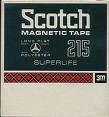
e
summer, we would get together at each others houses and record network
commercials promoting the fall shows. Plus spots like "NBC Week" and the
like. We both traded spots and theme songs. I still have all those
theme songs. (Except now they live on a hard drive) We would have
endless conversations regarding the sonic quality of different types of
Scotch recording tapes, and what happened on the last episode of Lost in
Space that we recorded.
After grade school, Mark and I lost
touch as he went on to a military school. And along the way in years to
come, my RQ-501S got lost in a move.
As a side note at this
point, two things. First, after a year of watching E-Bay, I finally got
another RQ-501S. Six months later, another appeared on E-Bay, this one,
with the BOX. That's important. Got that one too. Recently I acquired
one of its close cousins, the RQ-156S . My life is complete.
Secondly,
Mark had a Panasonic extension speaker for his machine. I don't know
the model number of the speaker, but it was really cool, because it hung
from the ceiling on a string, and was shaped exactly like the Jupiter 2
from Lost in Space. I know Panasonic made it, but I never found one. If
you happen to know anything about this speaker, please forward me the
info.
Now back to your regularly scheduled story.
Soon I was in

high
school. And it was here that I discovered high-end audio, and learned
exactly what an audiophile was. It was in the library of the school
where one day I discovered "High Fidelity Magazine" which began
publication back in 1951. It was published not to far away in Great
Barrington, Massachusetts. The school had all the back issues. And I
read all of them. During that time the library got some money for new
subscriptions and added "Stereo Review.
A whole new world opened
up to me in the pages of those magazines. Whenever I wasn't in a class, I
was in one of those magazines. It was in these magazines where I got
introduced to the likes of H.H.Scott, Fisher, Pioneer, JBL, Stanton,
Shure, Thorens, Bang & Olufsen, Teac, Ampex, Studer-ReVox, Marantz,
McIntosh, and a long list of others that manufactured equipment I could
only dream about owning.
I devoured the terminology and esoteric
terms like RMS amplifier values, damping factors, dB, VU, tracking
force, anti-skating, the advantages of a
Shibata
stylus or an eliptical, frequency response, sensitivity, selectivity,
bass reflex, and more. All that geeky stuff. I couldn't get enough of
it.
I set a goal for myself. I had to have a high-end audio
system. After a year or so and a full summer working, I accumulated
enough money to buy a system.
I spent a rather large sum of
money, and came home with a car full of gear. I got a Pioneer SPEC-1
amplifier (300 watts/ch) with the matching SPEC-1 pre-amp and the
matching FM tuner. I had JBL L-50s for the front and a pair of what
would prove to be rather inefficient smaller Advent speakers for the
rear. Yes, I went quad. Well, not exactly. I was hooked at the time on a
rather crude synthesized quad running a circuit I built designed by
David Hafler.
Radio
Shack came out with a box later on called a "Quatravox" that would do
the same thing. I ran the rear channels with an older Pioneer receiver.
I
added a Technics manual turntable (no automatics or semi-automatic for
me) with a high-end Audio-Technica cartridge with a Shibata stylus. Two
tape decks, a Teac open reel deck, and a ReVox cassette deck. SAE Noise
Reduction processor,and a 24 band equalizer with a graphic display, a
Technics metering unit for monitoring amplifier and pre-amp outputs, as
well as detector output from the tuner, and a few miscellaneous items
like an A/R stylus gauge, a Disc Washer, etc. I was playing audio in a
big way. I even had a rotatable 10 element antenna for FM DX'ing.

At
the time, I lived not to far away from WHRL 103.1. It was one of the
first FM Stereo stations to come on the air in upstate New York. It
programmed beautiful music, as did a few others. I became fascinated
with Drake/Chenault, and Schulke's "Matched Flow" beautiful music
formats.
I was always a fan of Top 40 music, but when I got the
new gear, I was constantly looking for something new to listen too. I
grew to like selected pieces of classical music, blues, and jazz. I
became a big fan of Wendy Carlos, Tomita, Vangelis, and other electronic
music artists. I made weekly trips to the record stores in the area.

My
friends and I at the time would compare opinions on the latest albums
we purchased. We would share our music with one another on open reel
tape or the occasional cassette. The subject of copyright never even
crossed our minds. We would periodically create "mix" tapes for each
other. If I got a reel from a friend and I liked it, I would generally
pick up the record at the store the next time out. (See it works) I had
around 500-700 albums in the collection in no time, from a lot of
different musical categories.
Through my interest in 11
meters, (yes I was on 11 meters for a few years, but then weren't we
all?) a radio friend introduced me to a friend of his that lived down
the street from him. His name was Joe, and he was also into high-end
audio. We both hit it off right away, and began not only talking about
the aspects of various new pieces of audio gear at the local shop, but
about the music. We would go over to each others houses and listen to
music for hours on end, discussing how certain tracks were mixed, or why
my JBL's seem transparent compared to his Bose systems that he always
thought colored the music a certain way.

He
was going into college at the time and soon joined the radio station
there. He was attending RPI in Troy. The college station there is
WRPI, a 10 kilowatt FM outlet on 91.5. He asked me to join him in producing his weekly program.
Now,
when you are an audio geek, there is nothing better than playing radio
at a technology college with all the latest toys. We both enjoyed taking
our listeners on a musical journey for three hours a week. Both of us
always longed for the day we could own Technics SP-1 turntables like the
station had. We both also volunteered at the local classical music
station
WMHT
which has a reading service for the print handicapped. We got to hone
our on-air talents reading the local papers. Not to mention the PBS
television station down the hall, we got to play with a lot of really
cool equipment.
It was during the time at WRPI that I discovered
artists like Genesis,Passport, Renaissance, Pentangle, Weather Report,
Keith Jarret, and a long, long list of others.
On what proved to
be our last show, we played tracks from our favorite artists. Joe was a
dyed in the wool Yes fan. I picked a few tracks from Camel. One of their
albums, Moonmadness, has a rather long track called "Luner Sea", that
has one of the best synthesizer solos you'll ever hear.
One
artist we both enjoyed was Renaissance. Our favorite album was
"Scheherazade and Other Stories". Favorite track? Trip To The Fair.
Sadly,
Joe passed away from leukemia during his sophomore year. The world lost
a budding architect. Today my equipment sits idle in a rack here in the
shack. I hope to get it going again some time soon.
I miss those
days. It just doesn't seem to be the same today. I love digital
technology, but I miss the sound of analog. I can do things in the
digital domain that used to take a rack full of equipment. (Don't tell
anybody, but right behind me right now, is a rack full of Behringer
audio processors, EQ's, Digital reverbs, an Optimod, and few other
things).
Today everyone seems to be in their own little digital
world. Everyone has a white wire leading down to the iPod in their
pocket. I don't see anyone talking about the music, let alone the audio
equipment.
Maybe they discuss the music and the gear via text messaging.
 I
have always had an interest in early television. Whenever an old
kinescope or early black and white videotape program comes on, I am
there to see it. Innovators in early television like Ernie Kovacs,
fascinate me. Imagine what Ernie could have done with todays technology.
I
have always had an interest in early television. Whenever an old
kinescope or early black and white videotape program comes on, I am
there to see it. Innovators in early television like Ernie Kovacs,
fascinate me. Imagine what Ernie could have done with todays technology. ls like Retro TV or This TV.
 Caddigan.


