Thursday, May 23, 2019

Morse Code Is 175 Years Old and Still as Useful as Ever

The first message sent by Morse code’s dots and dashes across a long distance traveled from Washington, D.C., to Baltimore on Friday, May 24, 1844-175 years ago. It signaled the first time in human history that complex thoughts could be communicated at long distances almost instantaneously. Until then, people had to have face-to-face conversations; send coded messages through drums, smoke signals and semaphore systems; or read printed words.
Thanks to Samuel F.B. Morse, communication changed rapidly, and has been changing ever faster since. He invented the electric telegraph in 1832. It took six more years for him to standardize a code for communicating over telegraph wires. In 1843, Congress gave him $30,000 to string wires between the nation’s capital and nearby Baltimore. When the line was completed, he conducted a public demonstration of long-distance communication.
Morse wasn’t the only one working to develop a means of communicating over the telegraph, but his is the one that has survived. The wires, magnets and keys used in the initial demonstration have given way to smartphones’ on-screen keyboards, but Morse code has remained fundamentally the same, and is still—perhaps surprisingly—relevant in the 21st century. Although I have learned, and relearned, it many times as a Boy Scout, an amateur radio operator and a pilot, I continue to admire it and strive to master it.

Easy sending

Morse’s key insight in constructing the code was considering how frequently each letter is used in English. The most commonly used letters have shorter symbols: “E,” which appears most often, is signified by a single “dot.” By contrast, “Z,” the least used letter in English, was signified by the much longer and more complex “dot-dot-dot (pause) dot.”
In 1865, the International Telecommunications Union changed the code to account for different character frequencies in other languages. There have been other tweaks since, but “E” is still “dot,” though “Z” is now “dash-dash-dot-dot.”
The reference to letter frequency makes for extremely efficient communications: Simple words with common letters can be transmitted very quickly. Longer words can still be sent, but they take more time.
 

Going wireless

The communications system that Morse code was designed for—analog connections over metal wires that carried a lot of interference and needed a clear on-off type signal to be heard—has evolved significantly.
The first big change came just a few decades after Morse’s demonstration. In the late 19th century, Guglielmo Marconi invented radio-telegraph equipment, which could send Morse code over radio waves, rather than wires.
The shipping industry loved this new way to communicate with ships at sea, either from ship to ship or to shore-based stations. By 1910, U.S. law required many passenger ships in U.S. waters to carry wireless sets for sending and receiving messages.
After the Titanic sank in 1912, an international agreement required some ships to assign a person to listen for radio distress signals at all times. That same agreement designated “SOS”—“dot-dot-dot dash-dash-dash dot-dot-dot”—as the international distress signal, not as an abbreviation for anything but because it was a simple pattern that was easy to remember and transmit. The Coast Guard discontinued monitoring in 1995. The requirement that ships monitor for distress signals was removed in 1999, though the U.S. Navy still teaches at least some sailors to read, send and receive Morse code.
Aviators also use Morse code to identify automated navigational aids. These are radio beacons that help pilots follow routes, traveling from one transmitter to the next on aeronautical charts. They transmit their identifiers—such as “BAL” for Baltimore—in Morse code. Pilots often learn to recognize familiar-sounding patterns of beacons in areas they fly frequently.
There is a thriving community of amateur radio operators who treasure Morse code, too. Among amateur radio operators, Morse code is a cherished tradition tracing back to the earliest days of radio. Some of them may have begun in the Boy Scouts, which has made learning Morse variably optional or required over the years. The Federal Communications Commission used to require all licensed amateur radio operators to demonstrate proficiency in Morse code, but that ended in 2007. The FCC does still issue commercial licenses that require Morse proficiency, but no jobs require it anymore.
A Morse code device, which is used to sends dots and dashes. Getty Images

Blinking Morse

Because its signals are so simple—on or off, long or short—Morse code can also be used by flashing lights. Many navies around the world use blinker lights to communicate from ship to ship when they don’t want to use radios or when radio equipment breaks down. The U.S. Navy is actually testing a system that would let a user type words and convert it to blinker light. A receiver would read the flashes and convert it back to text.
Skills learned in the military helped an injured man communicate with his wife across a rocky beach using only his flashlight in 2017.

Other Morse messages

Perhaps the most notable modern use of Morse code was by Navy pilot Jeremiah Denton, while he was a prisoner of war in Vietnam. In 1966, about one year into a nearly eight-year imprisonment, Denton was forced by his North Vietnamese captors to participate in a video interview about his treatment. While the camera focused on his face, he blinked the Morse code symbols for “torture,” confirming for the first time U.S. fears about the treatment of service members held captive in North Vietnam.
Blinking Morse code is slow, but has also helped people with medical conditions that prevent them from speaking or communicating in other ways. A number of devices—including iPhones and Android smartphones—can be set up to accept Morse code input from people with limited motor skills.
There are still many ways people can learn Morse code, and practice using it, even online. In emergency situations, it can be the only mode of communications that will get through. Beyond that, there is an art to Morse code, a rhythmic, musical fluidity to the sound. Sending and receiving it can have a soothing or meditative feeling, too, as the person focuses on the flow of individual characters, words and sentences. Overall, sometimes the simplest tool is all that’s needed to accomplish the task.

Article Courtesy Newsweek Tech News

Tuesday, May 21, 2019

NASA Invites Public To Submit Names To Fly Aboard Next Mars Rover


Although it will be years before the first humans set foot on Mars, NASA is giving the public an opportunity to send their names, etched on microchips, to the Red Planet with NASA's Mars 2020 rover, which represents the initial leg of humanity’s first round trip to another planet.

The rover is scheduled to launch as early as July 2020, with the spacecraft expected to touch down on Mars in February 2021.

The rover, a robotic scientist weighing more than 2,300 pounds, will search for signs of past microbial life, characterize the planet's climate and geology, collect samples for future return to Earth, and pave the way for human exploration of the Red Planet.

As we get ready to launch this historic Mars mission, we want everyone to share in this journey of exploration, said Thomas Zurbuchen, associate administrator for NASA's Science Mission Directorate  in Washington. It’s an exciting time for NASA, as we embark on this voyage to answer profound questions about our neighboring planet, and even the origins of life itself.

The opportunity to send your name to Mars comes with a souvenir boarding pass and frequent flyer points. This is part of a public engagement campaign to highlight missions involved with NASA's journey from the Moon to Mars. Miles are awarded for each flight, with corresponding digital mission patches available for download. More than 2 million names flew on NASA's InSight mission to Mars, giving each flyer about 300 million frequent flyer miles.

From now until Sept. 30th, you can add your name to the list and obtain a souvenir boarding pass to Mars. Point your web browser to:

https://go.nasa.gov/Mars2020Pass

The Microdevices Laboratory at NASA's Jet Propulsion Laboratory in Pasadena, California, will use an electron beam to etch the submitted names onto a silicon chip with lines of text smaller than one-thousandth the width of a human hair. At that size, more than a million names can be inscribed on a single dime-size microchip. The chip will ride on the rover under a glass cover.

NASA will use Mars 2020 and other missions to prepare for human exploration of the Red Planet. As another step toward that goal, NASA is returning American astronauts to the Moon in 2024. Government, industry and international partners will join NASA in a global effort to build and test the systems needed for human missions to Mars and beyond.

The Mars 2020 Project at JPL manages rover development for SMD. NASA's Launch Services Program, based at the agency's Kennedy Space Center in Florida, is responsible for launch management. Mars 2020 will launch from Cape Canaveral Air Force Station in Florida.

For more information on Mars 2020, visit: https://www.nasa.gov/mars2020

Friday, May 10, 2019

Hi everybody. My name is Giz, and I am the Chief Engineer of W2XBSradio. My human started this
blog and one of his friends that lives far away in a place called Arizona, suggested that I put up a
picture of myself. As you know I post regularly on my humans Facebook page, so now that I know he
has a blog, you will see more of me in future posts here too. More Later! giz

Friday, May 3, 2019

Passive WiFi On Microwatts

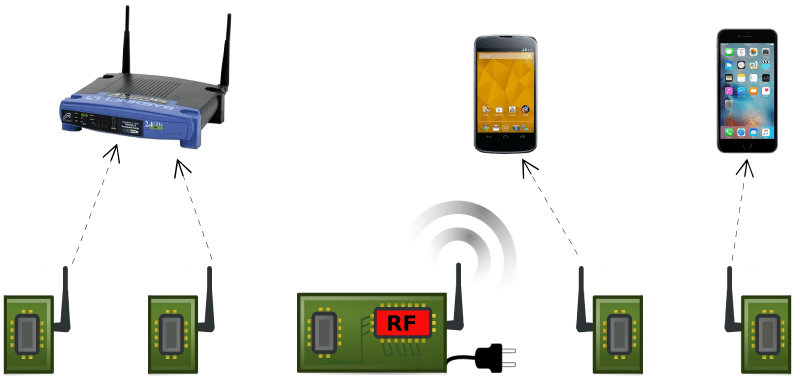
A lot of you use WiFi for your Internet of Things devices, but that pretty much rules out a battery-powered deployment because WiFi devices use a lot of juice. Until now. Researchers at the University of Washington have developed a passive WiFi implementation that uses only microwatts per device.
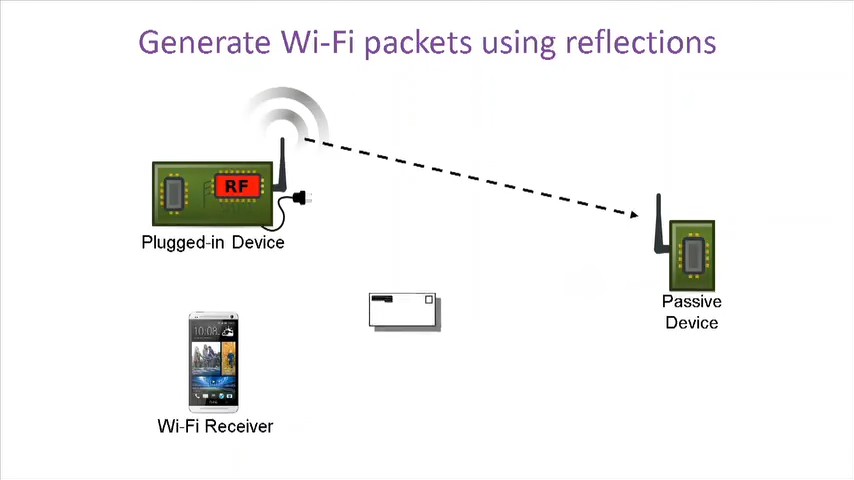
Working essentially like backscatter RFID tags do, each node has a WiFi antenna that can be switched to either reflect or absorb 2.4 GHz radiation. Your cell phone, or any other WiFi device, responds to this backscattered signal. All that’s missing is a nice steady signal to reflect.
passive_wifi-shot0008A single, plugged-in unit provides this carrier wave for multiple WiFi sensor nodes. And here’s the very clever part of the research: to keep the carrier from overwhelming the tiny modulated signal that’s coming from the devices, the plugged-in unit transmits off the desired frequency and the battery-powered units modulate that at just the right difference frequency so that the resulting (mixed) frequency is in the desired WiFi band.
If you’re a radio freak, you’ll recognize the WiFi node’s action being just like a frequency mixer. That’s what the researchers (slightly mysteriously) refer to as the splitting of the analog transmission stage from the digital. The plugged-in unit transmits the carrier, and the low-power nodes do the mixing. It’s like a traditional radio transmitter, but distributed. Very cool.
There’s a bunch more details to making this system work with consumer WiFi, as you’d imagine. The powered stations are responsible for insuring that there’s no collision, for instance. All of these details are very nicely explained in this paper (PDF). If you’re interested in doing something similar, you absolutely need to give it a read. This idea will surely work at lower frequencies, and we’re trying to think of a reason to use this distributed transmitter idea for our own purposes.
And in case you think that all of this RFID stuff is “not a hack”, we’ll remind you that (near-field) RFID tags have been made with just an ATtiny or with discrete logic chips. The remotely-powered backscatter idea expands the universe of applications.

Video Link: Video

Thursday, May 2, 2019


Listen to my rock radio show The Sanforized Hour. Heard every Friday Evening at 9pM Eastern (2am UTC) for the U.S. and repeated Saturdays at 5pM Eastern 21:00 UTC for the U.K and the continent. The Sanforized Hour Every Friday and Saturday on X1 - Albany N.Y.'s Home For Online Rock.

Wednesday, May 1, 2019

Netflix’s new high-quality audio adjusts to match your internet speeds

Netflix is rolling out an upgrade to its audio streaming technology that increases the maximum bitrate of its audio and allows it to adjust based on the speed of your internet connection. The streaming service’s new high-quality audio increases the maximum bitrate of a 5.1 audio mix to 640 kbps, and a Dolby Atmos mix to 768 kbps. The bitrate will also scale based on your internet speed, and can drop as low as 192 kbps in order to stop the video from having to buffer. The streaming service has used this adaptive approach before for its video feeds, which adjust dynamically to prevent them from cutting out. However, until now, the bitrate of a show’s audio has been determined at the beginning of a stream, with no option to adjust it once it has started. That could mean you’re stuck with lower-quality audio when your internet connection has more capacity, or a show has to buffer because it’s stuck on a higher bitrate. Even at Netflix’s maximum 5.1 audio bitrate of 640 kbps, it’s still compressing the audio a lot compared to the 24-bit / 48 kHz mastering sample frequency. But Netflix chose this bitrate because it believes it’s indistinguishable from the lossless master track, and hence you’d see no benefit from a higher bitrate. It adds that, over time, it expects these bitrates to change based on how efficient its encoders become. Netflix’s new high-quality audio is launching today. Courtesy The Verge News